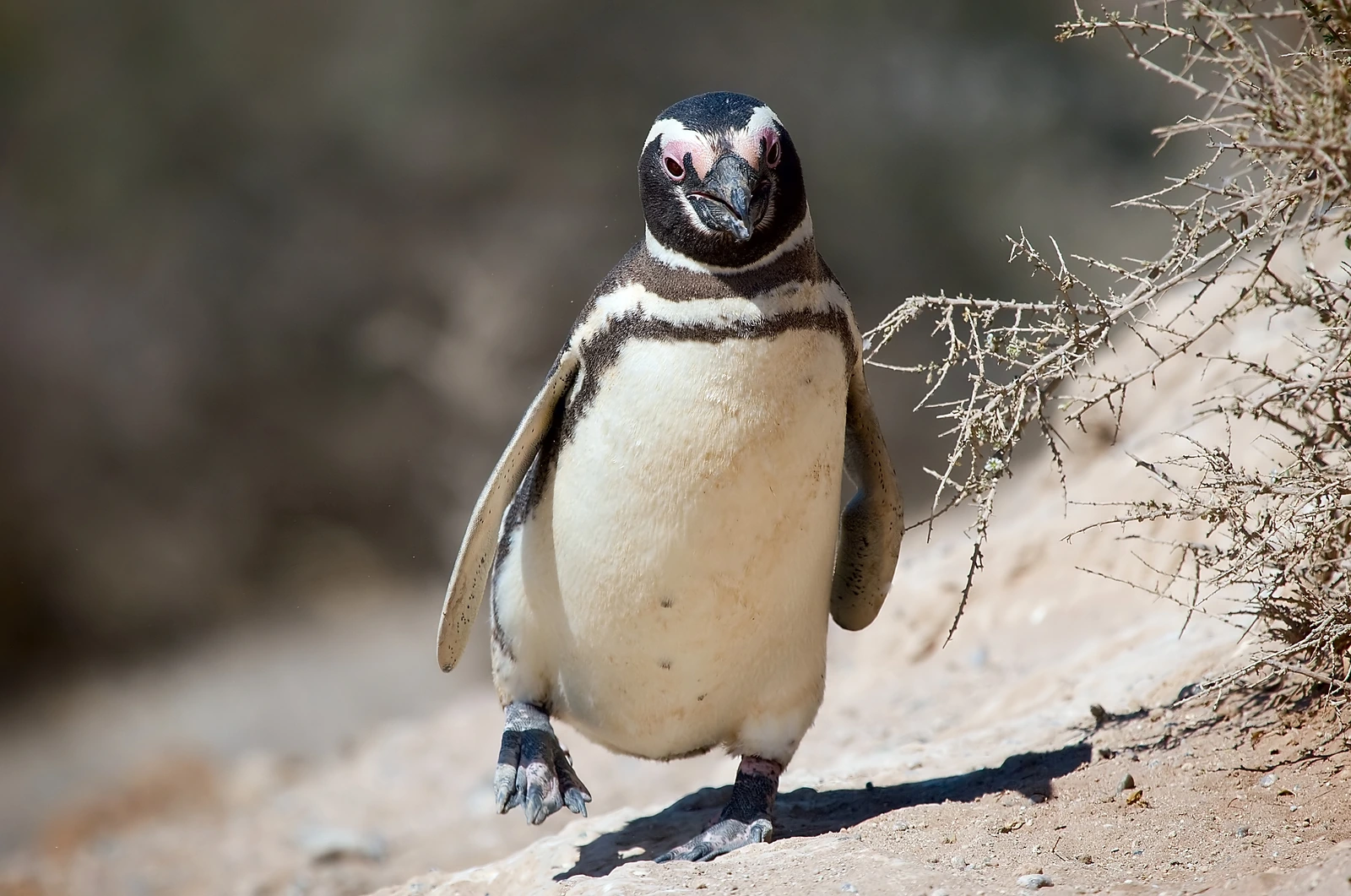
CHILE · ARGENTINA · SEABIRDS
PENGUINS
OF PATAGONIA
The shore gathers the colony.
The ocean sustains its life.
Photograph: David · CC BY 2.0
PATAGONIA IN DEPTH
Two worlds, one life
In a penguin colony, the ground is full of movement. There are routes to the water, shelters, encounters and pauses. What we see is only part of their lives: food comes from the sea, and many journeys extend far beyond the coast we visit.
Patagonia supports different penguin species and breeding habitats. The Magellanic penguin is among its most recognisable birds; other species inhabit islands and parts of Tierra del Fuego. Identifying them connects each image with its territory and natural history.
A colony is a place of life and research. Watching carefully reveals how land and ocean connect, and why conservation needs to encompass both.
Sources: CONICET · Penguin natural history and conservation · National Parks Administration · Isla Pingüino
01 — IDENTITY
Each species
has its place
Adult Magellanic penguins, Spheniscus magellanicus, have two dark bands across the front of the body and a black-and-white head pattern. Their colonies occur on southern South American coasts and islands. Juveniles look different from adults.
The southern rockhopper penguin, Eudyptes chrysocome, has yellow plumes along the sides of its head and reddish eyes. Isla Pingüino, off Santa Cruz, supports this species and Magellanic penguins. Their coexistence shows how one protected area can contain species with different behaviours.
Tierra del Fuego also offers opportunities to observe and study king penguins. Identifying a species does not justify transferring dates, numbers or conditions from one colony to another. Each place needs its own information.
Sources: Global Penguin Society · Magellanic penguin natural history · National Parks Administration · Isla Pingüino · Reserva Natural Pingüino Rey · Conservation and visits
02 — LIFE AT SEA
Flight takes a new form
underwater
Penguins are birds adapted to swimming and diving. Their wings work as flippers, and their bodies move efficiently through water. Watching them walk can obscure the importance of the marine environment, where they find much of what sustains them.
Plumage and body reserves contribute to insulation and energy balance. Feather care and replacement are part of the life cycle. Breeding, moulting and movement make different demands.
Automatically associating penguins with ice overlooks their diversity. Magellanic penguins inhabit temperate waters and can breed on arid coasts. Their presence depends on marine conditions and suitable places ashore as well as latitude.
Sources: CONICET · Magellanic penguins, ambassadors of Patagonia · CONICET · Penguin natural history and conservation
03 — BREEDING
Returning to land
to breed
Magellanic penguins breed in colonies, using burrows, spaces beneath vegetation and other shelters. Nest location connects protection with ground characteristics and local conditions. Adults share incubation and care.
The season includes establishing the nest, laying eggs and raising chicks. Trips to sea alternate with attending eggs and young. Food brought back to the colony links every journey to the chicks' opportunities for growth.
General descriptions help interpret the cycle but do not set an identical calendar across Patagonia. Latitude, environmental conditions and the colony can introduce differences. A photograph of an adult beside a juvenile shows one moment in that process.
Sources: Global Penguin Society · Magellanic penguin natural history · CONICET · The society of protected penguins
04 — MARINE NETWORKS
The colony
depends on the ocean
Fish and other marine organisms form the Magellanic penguin's diet. Prey availability changes through space and time. Foraging trips find resources but also consume energy and may take adults far from the colony.
Tracking devices reveal routes and feeding areas. The data help identify overlap with fishing, shipping and other human activities. Protection of a breeding site becomes stronger when it also considers the marine areas sustaining it.
A shore with many nests may depend on feeding grounds outside its administrative boundaries. This connection calls for cooperation between research, protected-area management and sea users. The visible horizon is only part of the system.
Sources: Global Penguin Society · Research and tracking · CONICET · Conservation and marine zoning
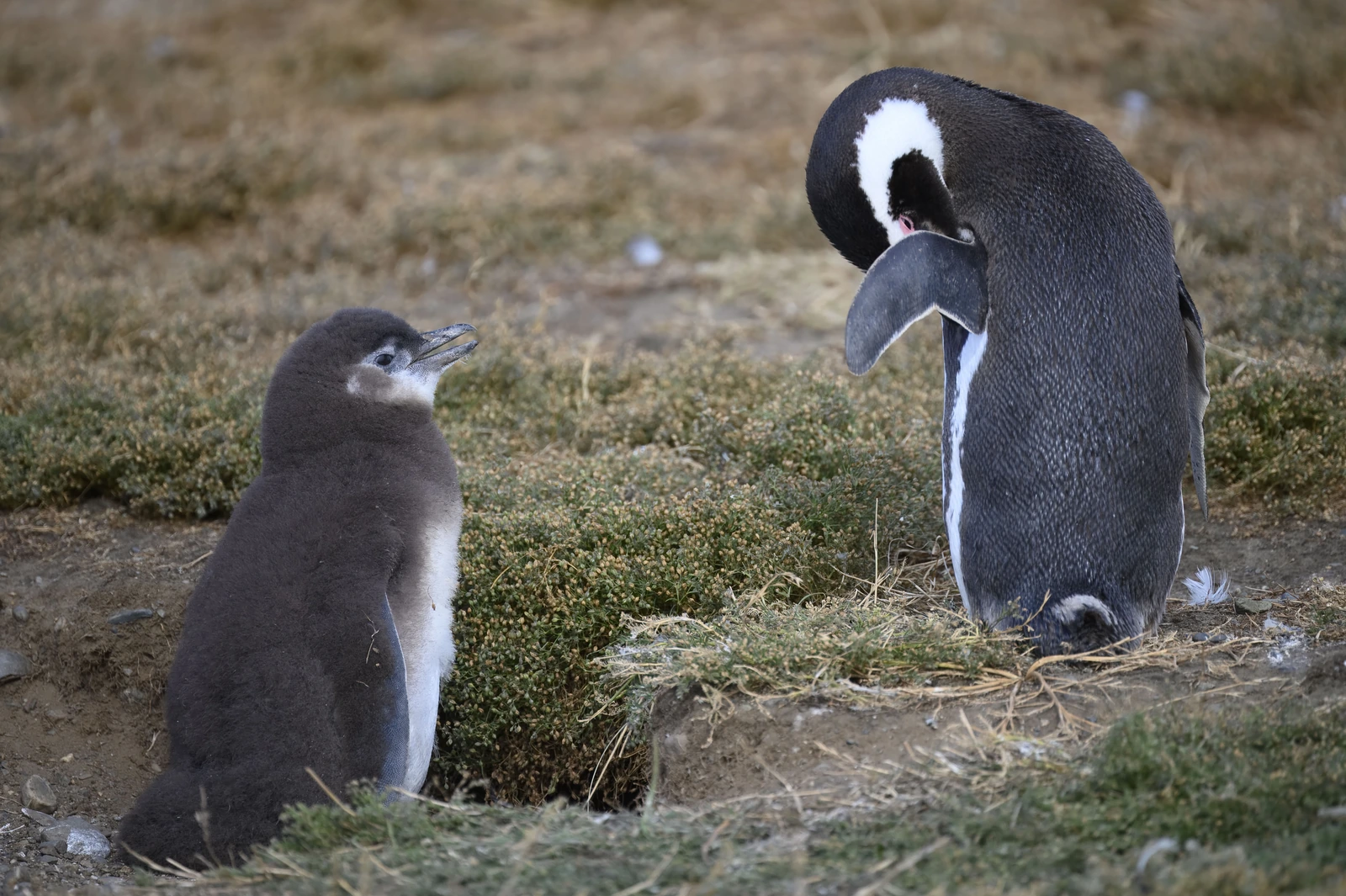
Photograph: lwolfartist · CC BY 2.0
05 — MOVEMENTS
The map
continues north
After breeding, many Magellanic penguins travel and spend long periods at sea. In the Atlantic, movements can take them towards Uruguayan and Brazilian waters. Their routes cover territories far larger than a colony's area.
Research uses observation and tracking to establish where birds go and what conditions they encounter. Results can vary between populations, ages and years. A documented route must retain its study context.
Thinking at this scale explains why threats can operate far from a penguin's birthplace. Breeding shores, feeding areas and movement corridors form an ecological continuum.
Sources: CONICET · Conservation and marine zoning · CONICET · Penguin natural history and conservation
06 — TERRITORIES
Different coasts,
different experiences
In Chile, Los Pingüinos Natural Monument includes Magdalena and Marta islands in the Strait of Magellan. Its management information connects visits with conservation, emphasising birds' passage between colony and sea.
In Argentina, Monte León brings together steppe and Atlantic shore, with a Magellanic penguin colony among its natural features. Isla Pingüino also offers an introduction to southern rockhoppers. Access and navigation conditions are specific to each area.
Tierra del Fuego's Reserva Natural Pingüino Rey describes a project combining research, environmental education and visits. These examples offer different ways to observe seabirds. Before travelling, consult each site's current management information for availability and conditions.
Sources: CONAF · Los Pingüinos Natural Monument · National Parks Administration · Monte León · National Parks Administration · Isla Pingüino · Reserva Natural Pingüino Rey · Conservation and visits
07 — RECENT RESEARCH
One colony does not
represent the species
A study published in Scientific Reports in January 2026 and publicised by CENPAT in May analysed 65 colony time series for Magellanic penguins in the southwestern Atlantic. It combined data from the Argentine coast with an aggregated record for the Malvinas/Falkland Islands to examine more than three decades of change.
The overall trend was statistically consistent with stability, while some colonies declined and others grew. The central estimate changes from slightly negative to positive when the Malvinas/Falkland record is excluded, but both confidence intervals include stability. This should not be presented as a statistically confirmed general increase.
The conclusion does not mean an absence of threats, nor does it automatically apply to all Chilean populations. It shows how scale changes interpretation: a local decline deserves attention, and a regional trend needs to be read in light of its methods and geographical scope.
08 — CONSERVATION
Changes at sea
reach the shore
Pollution, fishery interactions, changing food availability and degradation of breeding grounds are among the problems studied in penguins. Human disturbance and introduced animals add pressure at certain colonies.
CONICET research has documented contamination by microplastics and other debris in Magellanic penguins. Finding these materials raises questions about exposure, pathways of entry and effects. Detecting a pollutant and measuring its consequences are connected but distinct stages.
Conservation must combine threat reduction with monitoring of outcomes. Birds can indicate marine conditions when their data are interpreted alongside other factors. An image of abundance on land is not enough to assess ocean health.
Sources: CONICET · Microplastics in Magellanic penguins, 2023 · Global Penguin Society · Research and tracking
09 — ENCOUNTERS
Keep the route
to the water clear
A visitor trail may cross a penguin's everyday route. Stopping and giving it room lets it continue between nest and sea. Isla Magdalena's management particularly stresses avoiding interruptions to that passage.
Observe from permitted places without feeding, chasing or touching birds. This allows you to know a colony while respecting its activities. Animal behaviour and rangers' guidance shape the visit; check the rules for each site.
A good photograph can be made from a suitable distance through framing and patience. The encounter means more when the image preserves spontaneous behaviour and the bird continues on its way.
Sources: CONAF · Los Pingüinos Natural Monument · National Parks Administration · Monte León
PATAGONIAN WILDLIFE
The shore brings them together.
The sea connects them.
Penguins reveal a relationship running through Patagonia: a place on land depends on an aquatic world in motion. Knowing the species, observing their cycles and following research helps us see each colony as part of that web.
ESSENTIAL QUESTIONS
Keep
exploring
Are all Patagonian penguins Magellanic penguins?
No. The region contains different species and colonies. Isla Pingüino, for example, supports Magellanic and southern rockhopper penguins.
Do they always live at the colony?
No. They feed at sea, and their cycles involve movement. Many Magellanic populations make long seasonal journeys.
When can they be observed?
It depends on the species and location. Consult the calendar and current conditions provided by the management of the colony you want to visit.
Does one colony's decline mean that all are declining?
Not necessarily. The study publicised by CENPAT in 2026 shows different colony trends and stresses the importance of geographical scale.