ARGENTINA · SANTA CRUZ · RÍO PINTURAS
CUEVA DE
LAS MANOS
Stone holds the images.
The landscape holds their connections.
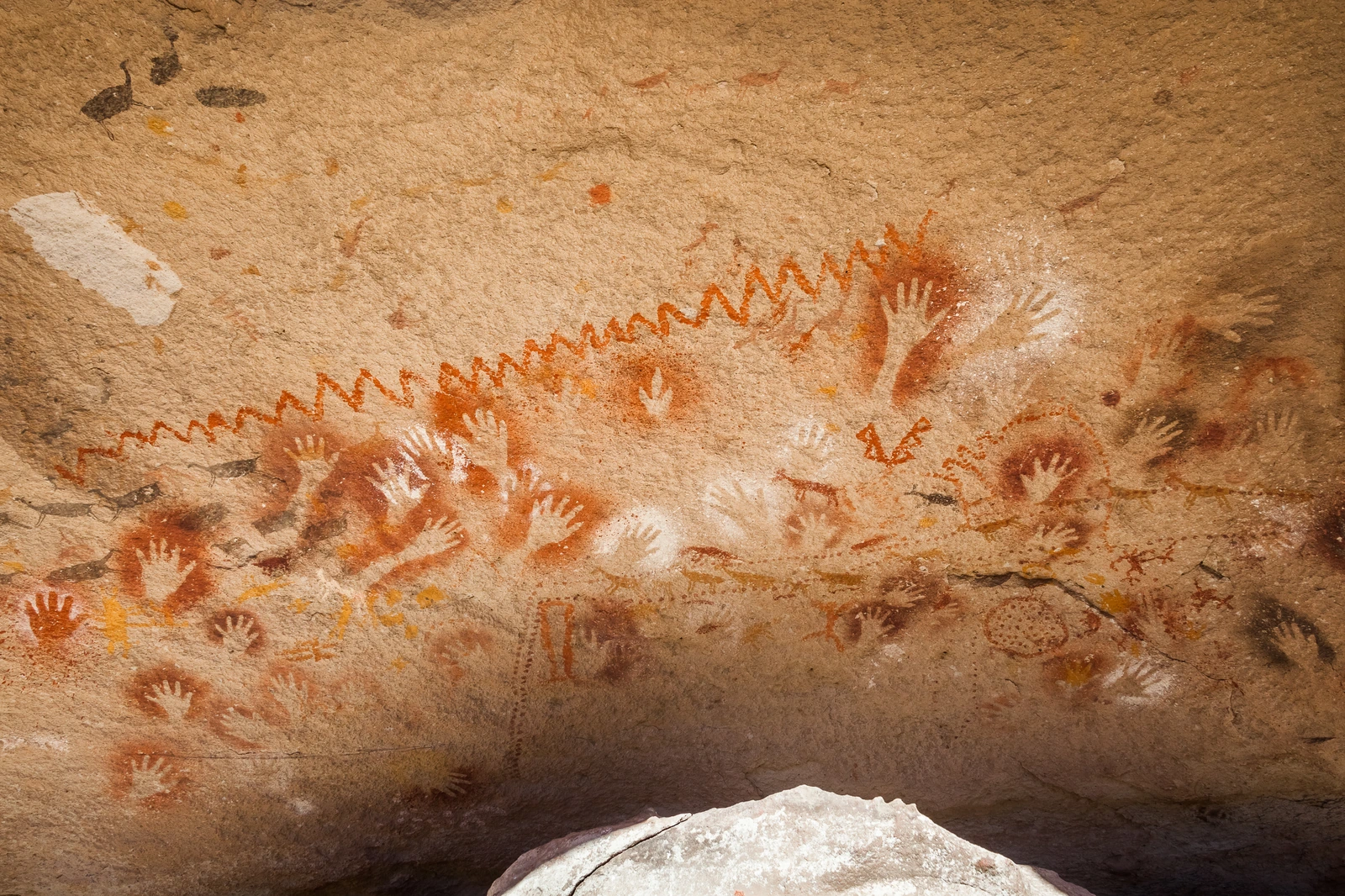
Photograph: Fjturban · Public domain
PATAGONIA IN DEPTH
A presence on the rock
A hand appears on the rock, then another nearby. Size, colour and position vary. The gesture feels immediate; the distance in time is immense. In the Pinturas River canyon, these images form one of the most recognisable expressions of Patagonia’s cultural heritage.
Cueva de las Manos lies in northwestern Santa Cruz, Argentina. The name refers to a site comprising a cave, rock shelters and painted surfaces within a landscape of canyons and steppe. Its imagery includes hands, animals, hunting scenes and geometric motifs.
The site was inscribed on the World Heritage List in 1999. Understanding it brings rock art, archaeology and conservation together. The paintings offer an encounter with ancient societies, while interpreting their meanings requires a clear distinction between evidence and possibility.
Sources: Argentina · Viewing the paintings at Cueva de las Manos · UNESCO · Cueva de las Manos: universal value and conservation
01 — TERRITORY
The wall
belongs to the canyon
The encounter begins with the landscape. The steppe opens into a canyon, and the rock provides shelter. The paintings belong to this setting, connected to routes, resources and a long history of human occupation.
A photograph of hands alone leaves much of that geography out. The river, slopes and surrounding spaces invite questions about movement and the use of land. Other sites in the Pinturas basin broaden our understanding of the images.
A proposed extension on UNESCO’s Tentative List brings together associated places in the basin. That proposal must be distinguished from the site already recognised as World Heritage: they are different stages in international heritage protection.
Sources: UNESCO · Associated sites of the Pinturas basin, Tentative List
02 — IMAGES
Presence
in an outline
Hand stencils are made by applying pigment around a hand held against a surface, leaving its silhouette. At Cueva de las Manos, they appear in groups and in different colours. Each preserves a direct relationship between a body and the surface it touched.
The gesture suggests a human presence, but does not automatically identify the person or the purpose of the act. Differences in size and arrangement can be studied; assigning an individual story to each hand goes beyond what the image can establish.
The paintings also include guanacos, human figures and abstract forms. This diversity points to different repertoires and periods. The site’s familiar name describes one particularly visible part of a much wider whole.
Sources: Argentina · Viewing the paintings at Cueva de las Manos · CONICET Digital · Cueva de las Manos: sequence and pigments
03 — LIFE AND REPRESENTATION
The guanaco
crosses the painting
Hunting scenes bring animals and human figures together in dynamic relationships. Guanacos and scenes of pursuit or collective hunting stand out in the earliest sequence studied. The imagery relates to livelihoods grounded in knowledge of wildlife and terrain.
Archaeologists compare these depictions with occupation materials, tools and remains recovered in excavations. Together they help trace activities and changes, although a painted scene should not be read as a literal photograph of an event.
Guanacos remain part of the Patagonian landscape. Seeing them today helps us understand scale and movement, while research keeps present ecosystems distinct from the conditions in which the painters lived.
Sources: CONICET Digital · Cueva de las Manos: sequence and pigments · CONICET · Research in the Pinturas canyon, 2022
04 — MATERIALS
Colour
has a history, too
The paintings were made with mineral pigments. Analyses and site descriptions identify materials producing reds, whites, yellows and blacks. Preparing and applying them required technical choices about sourcing, grinding and use.
Overlapping images help establish a sequence: where one painting partly covers another, it is later at that point of contact. Colour, form and position provide clues, but must be combined with archaeological context to construct a chronology.
Preserving pigment means preserving its relationship with the rock. The painted surface and nearby deposits hold complementary information. Removing a fragment destroys part of that relationship, even when the detached piece seems to retain its image.
Sources: UNESCO · Cueva de las Manos: universal value and conservation · CONICET Digital · Cueva de las Manos: sequence and pigments
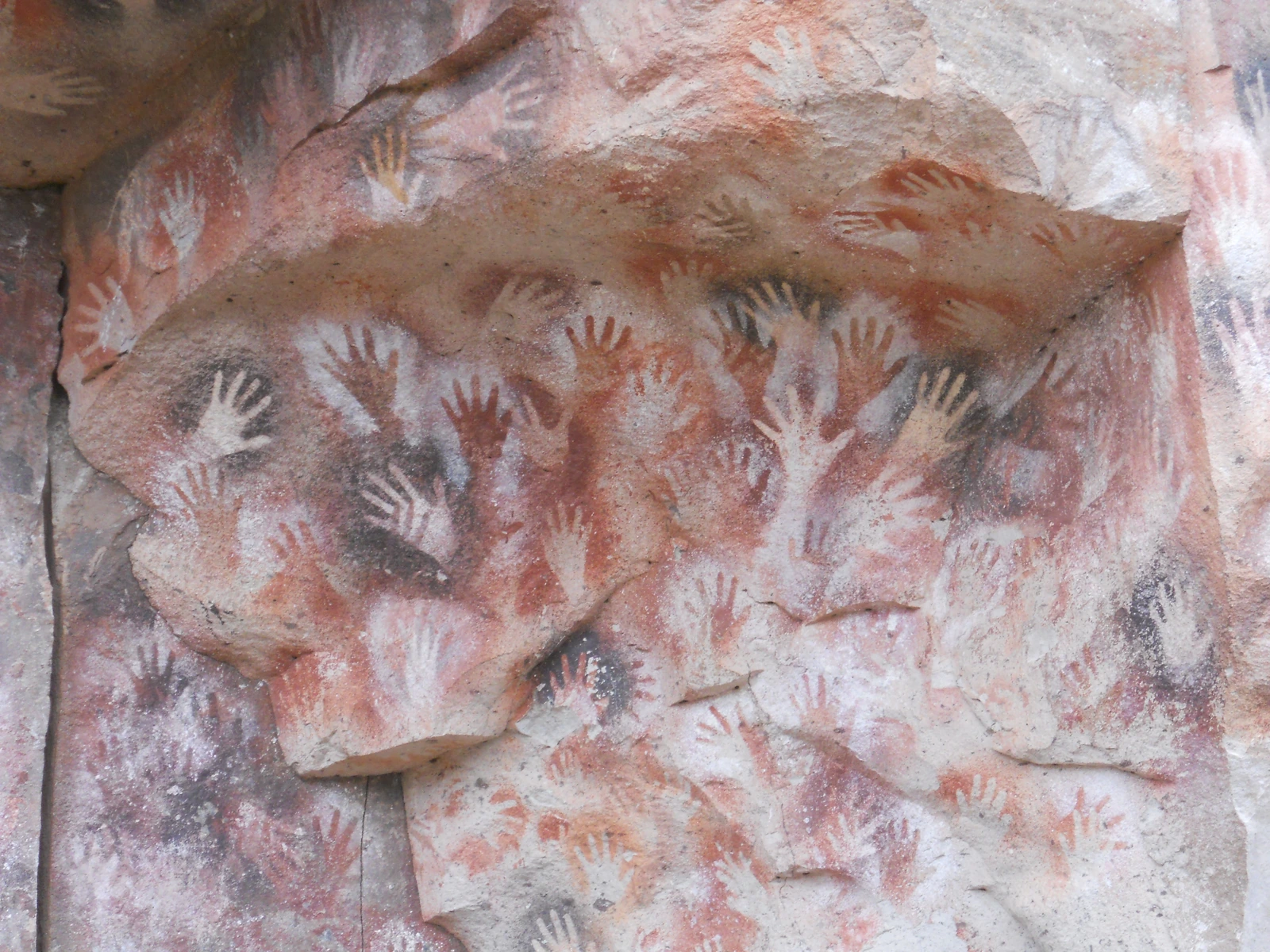
Photograph: Maclemo · CC BY-SA 3.0
05 — CHRONOLOGY
Returning
through the ages
The artistic sequence spans millennia. Studies distinguish stylistic groups and changes in subjects, forms and overlaps. The earliest paintings studied date to roughly nine thousand years before present; the site’s history includes later phases.
The term before present, abbreviated BP, is a convention used in archaeological dating. Dates may be given as radiocarbon ages or calibrated ages. Comparing figures requires knowing which method and which sequence each publication describes.
Carlos Aschero explains how excavations and later field seasons led to revisions of relative chronologies. That research history cautions against giving all the hands and paintings a single date: the site records a long, varied continuity.
Sources: Carlos Aschero · Rock art as an archive of memory, 2021 · CONICET Digital · Cueva de las Manos: sequence and pigments
06 — KNOWLEDGE
What we know
and what we ask
Rock art can be studied within social and territorial relationships. Aschero proposes considering its roles in transmission, memory and identity, while distinguishing these from specific meanings that the available evidence cannot always recover.
This distinction allows interpretation without turning possibilities into certainties. An image may preserve choices and relationships that mattered to its makers, while some of their context remains unknown to us. Caution opens up research instead of closing the question.
Ethnic attribution also calls for care. Communities that painted thousands of years ago cannot automatically be identified by a later historical name. Linking archaeology and Indigenous peoples requires evidence and an understanding of their different timescales.
Sources: Carlos Aschero · Rock art as an archive of memory, 2021 · INAPL · Dialogues across time, 2022
07 — ARCHAEOLOGY
A site
that keeps raising questions
Research associated with Carlos Gradin and Carlos Aschero laid foundations for understanding the sequence at Cueva de las Manos. Later campaigns continued in the Pinturas canyon, bringing together excavation, image recording and landscape analysis.
Teams combine different specialisms to study occupations and environments. Recording small traces, their positions and their relationships matters as much as documenting spectacular panels. Research depends on preserving what we do not yet know how to interpret.
INAPL’s public outreach, including the series Dialogues across time, shows how those questions take shape. It presents the paintings, their ancient makers and the contemporary work of documentation and preservation.
Sources: CONICET · Research in the Pinturas canyon, 2022 · INAPL · Dialogues across time, 2022
08 — HERITAGE
Protection
calls for cooperation
Argentina declared Cueva de las Manos a National Historic Monument through Law 24,225 in 1993. World Heritage inscription in 1999 added international recognition to a heritage whose care also depends on provincial and local institutions.
Management brings together conservation, safety, research and visits. In 2025, Santa Cruz documented the creation of an interinstitutional team for Cueva de las Manos Provincial Park. Coordination helps address the site’s interconnected needs and responsibilities.
Heritage recognition does not freeze a landscape or replace its management. Monitoring surfaces, training guides and involving local communities help preserve the images and their contexts for public knowledge and research.
Sources: Argentina · Law 24,225: heritage designation · Santa Cruz · Interinstitutional management team, 2025
09 — VISITING
Come close
without leaving a mark
A visit places the paintings within their landscape, following the route and guidance provided on site. Current official information should guide access and planning: road and site conditions can change.
Refraining from touching, wetting, scratching or removing material preserves surfaces and context. The rock is part of an irreplaceable record. A new mark interferes with earlier ones and can cause damage far beyond its visible size.
A guide’s explanation reveals scenes that a hurried glance might miss. Looking again, comparing colours and noticing how a panel relates to the canyon turns the visit into a slower reading. Photography can accompany it, subject to current rules.
Sources: Argentina · Viewing the paintings at Cueva de las Manos · Santa Cruz · Interinstitutional management team, 2025
HISTORY AND HERITAGE
The hand withdrew.
The presence remains.
Cueva de las Manos combines an intimate encounter with an almost unimaginable depth of time. Its value lies in the images and their connections to the landscape. Reading them carefully reveals a Patagonia inhabited over millennia and keeps its questions open.
ESSENTIAL QUESTIONS
Keep
exploring
Where is Cueva de las Manos?
In the Pinturas River canyon, in northwestern Santa Cruz, Argentina, in the area near the town of Perito Moreno.
Are all the paintings the same age?
No. The site preserves a sequence made over millennia, with different groups and overlapping images.
What do the paintings show besides hands?
Guanacos, human figures, hunting scenes and geometric motifs, among other elements of the studied repertoire.
When did UNESCO recognise the site?
It was inscribed on the World Heritage List in 1999. The proposal to include associated sites in the basin is a separate process.