CHILE · ARGENTINA · SOUTHERN WETLANDS
PATAGONIAN
PEATLANDS
Water remains.
The ground holds time.
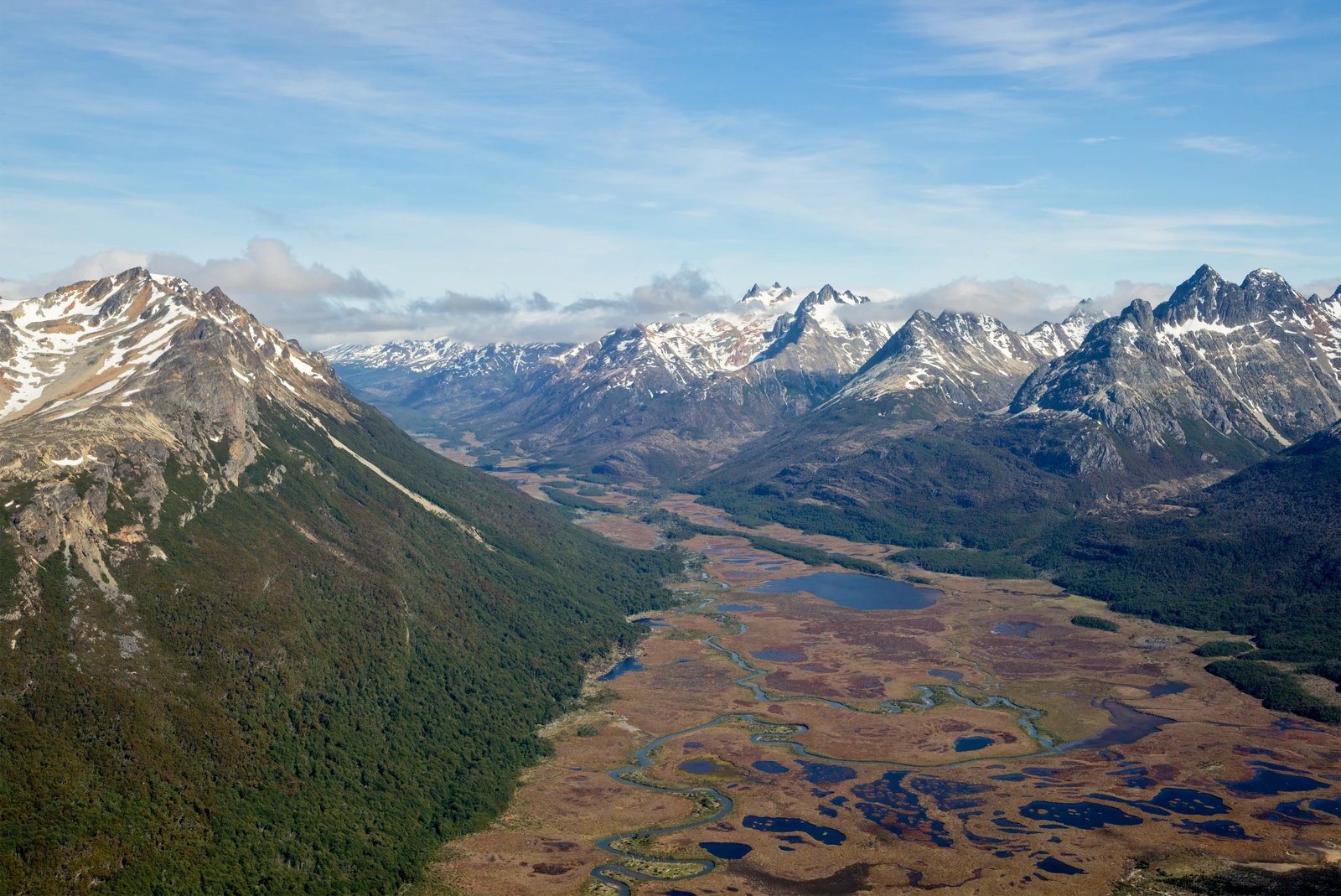
Photograph: Godot13 · CC BY-SA 4.0
PATAGONIA IN DEPTH
Time beneath the moss
From a distance, a peatland may look like a low stretch of ground between forests and mountains. Come closer and mosses, small changes in level, plants and water emerge. Beneath this cover lies another kind of depth: plant matter accumulated slowly, holding carbon and traces of past environments.
Peatlands are wetlands where peat forms and accumulates. In Patagonia they shape landscapes in Tierra del Fuego, Magallanes, Aysén and other southern areas. Their importance lies in their soil and in the way water, vegetation and climate sustain the system.
Understanding them means looking beyond a carpet of moss. Living vegetation, the organic deposit and the catchment sustain one another. Altering any one of these parts can change how the whole system works.
Sources: Universidad Austral de Chile · Valuing peatlands · MMA · Wetland types
01 — FORMATION
Growth
outpaces decay
Plants take up carbon as they grow. When they die, some of their remains enter the soil. In a peatland, waterlogged conditions and the resistance of certain plant materials slow decomposition, allowing organic matter to accumulate.
Peat contains partly decomposed plant remains. The deposit grows when production and accumulation exceed losses over time. That balance depends on local conditions: peatlands do not share one depth, age or rate of growth.
Today's soil is the outcome of a long history. Its formation helps explain why removing a deep layer or changing drainage can erase processes whose recovery takes far longer than the human intervention itself.
Sources: Jorge Hoyos-Santillán · Peatlands and climate change, CR2, 2020
02 — LIVING COVER
A world
at moss level
Mosses of the genus Sphagnum play an important role in many southern peatlands. Their structure retains water and helps create conditions favourable to organic accumulation. The living cover and the peat deposit are connected, but distinct, components.
Patagonia also has peatlands dominated by other plants. Tierra del Fuego includes areas with sedges, cushion vegetation and wooded environments on organic soils. Identifying the peatland type helps explain its functioning and conservation needs.
Research into Sphagnum management and restoration considers the recovery of vegetation cover and relationships with harvesting communities. Being able to restore vegetation at a site is not the same as immediately rebuilding the peat deposit that was lost.
Sources: IDeA project ID21I10024 · Sphagnum management and restoration · Argentina · Vinciguerra Glacier and associated peatlands
03 — CATCHMENTS
Where water
stays
Peatlands belong to catchments and networks of wetlands. Water enters, is stored and moves according to relief, soil and vegetation. Their capacity to retain and regulate water contributes to relationships between rainfall, watercourses and nearby environments.
The image of a sponge helps explain retention, though it simplifies a variable system. Not every peatland responds to rainfall in the same way, nor can peatlands replace every form of flood control. Understanding a site requires observations of water levels, connections and seasonal changes.
At catchment scale, protecting these wetlands can sustain important functions for biodiversity and human communities. Conservation must also consider their edges: a road, ditch or land-use change beyond the visible cover can still alter their water.
Sources: MMA · Wetland types · UNEP · Peatland protection, water and climate
04 — CLIMATE
A store
worth keeping
The climatic importance of peatlands includes the carbon they already hold. A stock is the quantity stored; a flux describes what enters or leaves over a period. Keeping these concepts distinct avoids confusing a large accumulated store with an equally large annual uptake.
Peatlands exchange gases with the atmosphere. Their balance depends on vegetation, water, temperature and other processes, and includes methane emissions. Conservation protects a whole system whose climate effects cannot be reduced to one figure for uptake.
United Nations global assessments stress that degradation can turn long-standing stores into sources of greenhouse gases. Keeping peatlands in good condition and avoiding further disturbance is therefore an important part of conservation and restoration.
Sources: Jorge Hoyos-Santillán · Peatlands and climate change, CR2, 2020 · UNEP · Global Peatlands Assessment, 2022
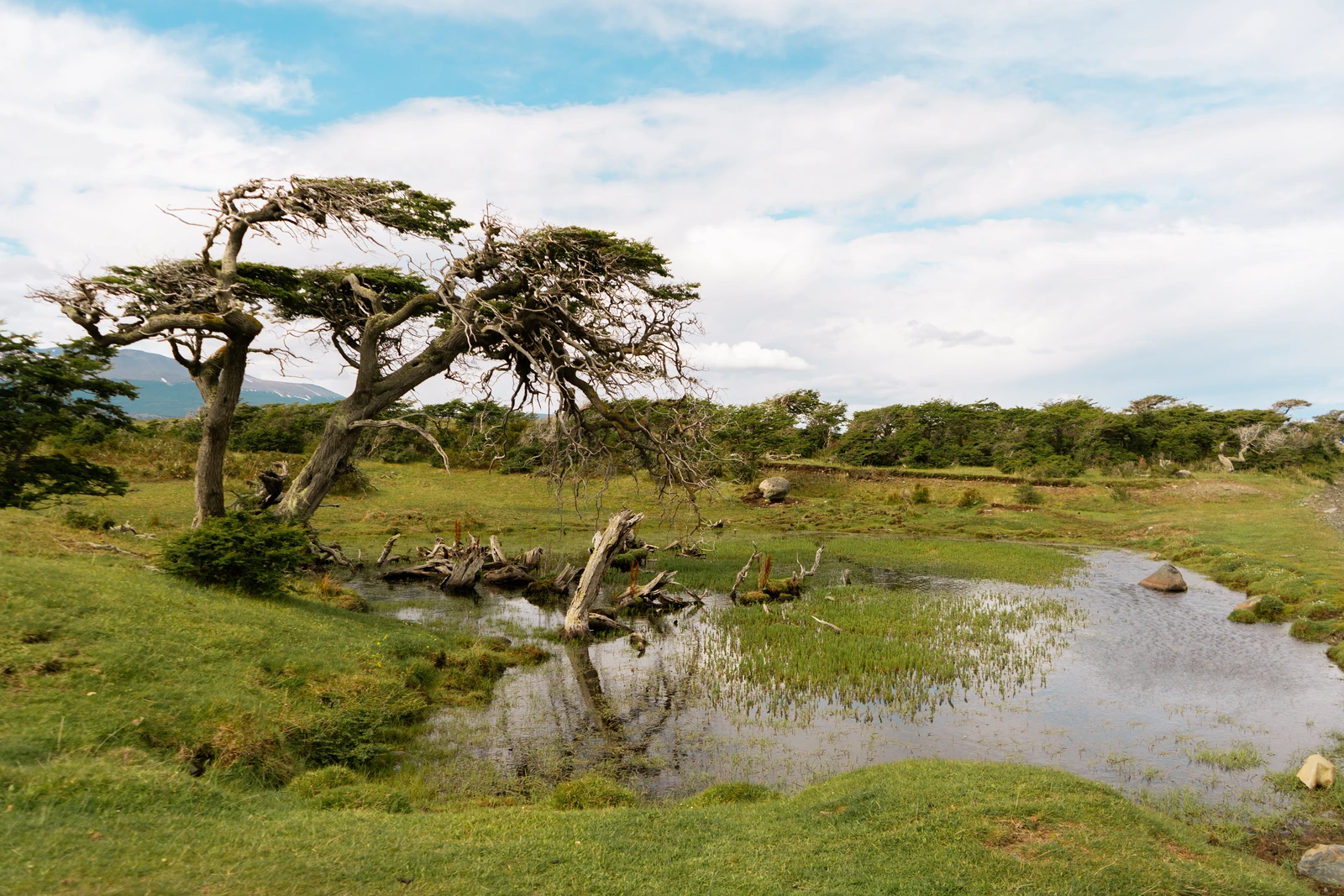
Photograph: Benjarte · CC BY-SA 4.0
05 — TIERRA DEL FUEGO
One island,
many peatlands
At the eastern end of Isla Grande, Península Mitre brings together native forests, watercourses, peatlands and coastal marine environments. Its designation as a Ramsar Site in August 2024 recognises a group of wetlands of international importance.
Argentina's official information describes a major concentration of different peatland types, valuable as a carbon store and habitat. Protection concerns the continuity of these environments and their catchments, rather than a single moss species alone.
Elsewhere on the island, the Ramsar Site Vinciguerra Glacier and Associated Peatlands links high-altitude environments, lakes, peatlands and forest. This association shows how the Fuegian landscape brings ice and organic soil into distinct systems connected through water.
Sources: Argentina · Península Mitre Ramsar Site · Convention on Wetlands · Península Mitre · Argentina · Vinciguerra Glacier and associated peatlands
06 — ENVIRONMENTAL MEMORY
The soil
is an archive too
Peat deposits can preserve remains and signals from earlier environments. Studying them helps reconstruct changes in vegetation, climate conditions and landscape dynamics. The value of the record depends on its preservation and the context of samples.
Reading this archive requires scientific work: dating, material analysis and comparison between layers. A sample's depth does not automatically give its age, because accumulation rates and conditions can change within a single deposit.
Peatlands thus combine ecological and research value. Conserving them keeps open the possibility of asking new questions about environmental history. Apparently uniform soil can contain differences revealed only by careful observation.
Sources: Universidad Austral de Chile · Valuing peatlands · UNEP · Global Peatland Hotspot Atlas, 2024
07 — CHANGE
When water
no longer sustains
Drainage changes soil conditions and can encourage decomposition of material previously preserved. Extraction, fire and certain land-use changes affect the continuity of the cover and deposit. Droughts and other climatic shifts add pressure.
Threats differ in scale and cause. A ditch, material extraction or extensive intervention calls for a specific assessment. Comparing sites requires knowledge of the peatland type, its condition and its relationship with its surroundings; the same technique does not have identical effects everywhere.
The 2024 Global Peatland Hotspot Atlas brings together information on distribution and threats to guide decisions. It reminds us that protection depends on knowing the land and including conservation in planning before damage forces an attempt at recovery.
Sources: UNEP · Global Peatland Hotspot Atlas, 2024 · UNEP · Global Peatlands Assessment, 2022
08 — CONSERVATION
Protecting
how it works
In Chile, Law 21.660, published in April 2024, established a framework for environmental protection of peatlands. Its aims include conservation, water regulation, biodiversity, and climate change mitigation and adaptation. Consult the law and its instruments currently in force for provisions and procedures.
Restoration may include recovering water conditions and vegetation cover, with monitoring of results. Applied research in southern Chile examines these processes and their relationship with moss management. A restored peatland needs assessment: a green surface alone does not demonstrate full recovery.
During a visit, authorised routes allow observation with less disturbance to the wetland. Care begins with recognising where the peatland is, how its water moves and what access conditions its managers set. Looking closely can be enough to discover its complexity.
Sources: Library of the National Congress of Chile · Law 21.660 · IDeA project ID21I10024 · Sphagnum management and restoration · UNEP · Peatland protection, water and climate
WATER AND LAND
The landscape lies low.
Its depth is immense.
Peatlands broaden the way we see Patagonia. Alongside mountains and glaciers, they sustain a heritage that grows slowly and depends on water. Conserving it means allowing processes that began long before our visit to continue.
ESSENTIAL QUESTIONS
Keep
exploring
Are peat and peatland the same?
Peat is partly decomposed organic matter. A peatland is the wetland ecosystem where that material forms and accumulates.
Are all peatlands covered in Sphagnum?
No. There are different plant communities and peatland types, including environments dominated by other plants.
Why do they matter for climate?
They preserve large carbon stores. Degradation can change that storage and increase emissions; annual uptake and accumulated carbon are different measures.
Is restoring a damaged peatland easy?
Restoration depends on the damage and the site, and must recover processes such as the water regime. Vegetation cover and the deep deposit have different recovery times.